
The SMB Website Conversion Report: What Small Business Websites Still Get Wrong

A small business website can look active on the surface. People are visiting, pages are getting views, and traffic shows up in the report.
But traffic does not always turn into calls, form submissions, or qualified inquiries.
That is one reason JRS Mar/Com began looking more closely at website behavior over the past several months. Not only did we want to know how many people visited a website, but we wanted to understand what happened after they arrived.
We started asking:
- Did blog readers move toward service pages?
- Did visitors reach the contact page?
- Did they view testimonials, case studies, or other proof before taking action?
- Did form views turn into form submissions?
- Did search visibility connect to meaningful website behavior?
- Were the right traffic sources bringing the right visitors?
If a website gets traffic but no leads, the next question is not always, “How do we get more traffic?” Sometimes, the better question is, “Where are people getting stuck?”
Our goal was not to create a more complicated report but rather to understand how people actually move through a website, where they keep going, and where they stop.
Here’s what we discovered.
Visibility Often Starts With Specific Questions, Not Broad Search Terms
In JRS’s own Semrush tracking, our strongest Q3 visibility came from the Marketing System topic, particularly our article “Don’t Hire a Marketer. Hire a Marketing System.” Terms like “hire a marketing system” and “marketing system vs hiring a marketer” gained measurable traction before broader service terms did.
Many marketing businesses like ours want to be found for broad searches like “marketing agency,” “SEO services,” or “website design.” Those searches are valuable, but they are also more competitive and less specific. Our tracking revealed that the clearer movement came from content tied to a more defined question: should a business hire a marketing system instead of simply adding another disconnected marketing task?
That gave us a useful signal. The content was not just ranking for a keyword. It was helping JRS become more visible around our unique approach to marketing.
This is a helpful reminder for small businesses in any industry. A lead-generating website does not always start by winning the broadest possible search term. Sometimes, the first meaningful opportunity comes from answering a specific question your customer is already asking.
Search visibility is only the first step, though. Once someone lands on the page, the website still has to help that person understand the offer, trust the business, and know what to do next.
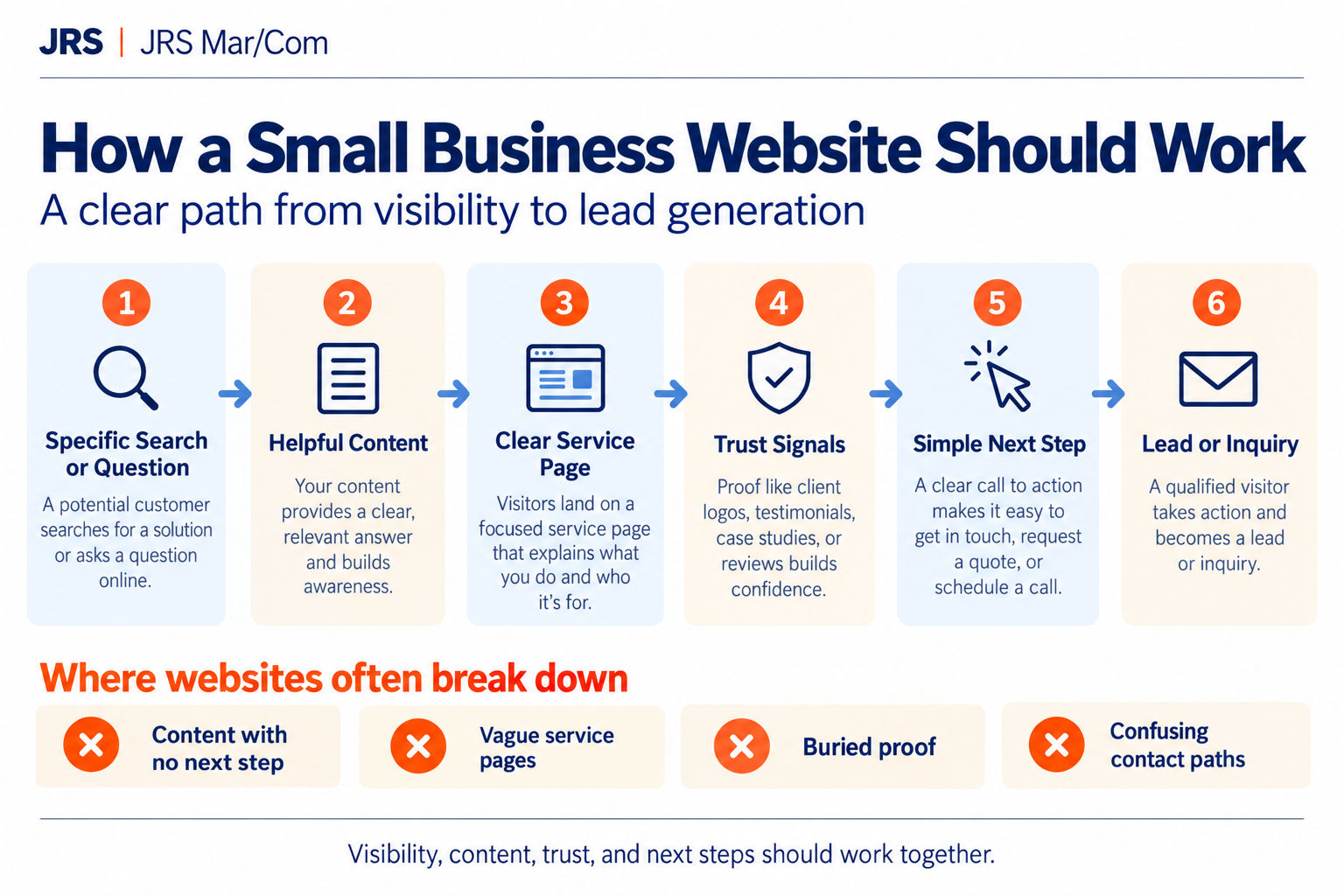
What Small Business Websites Still Get Wrong
They Treat Traffic as the Goal
Website traffic can look encouraging, but traffic alone does not tell you whether your website is doing its job.
A business also needs to know what people do after they arrive. Are they reading key service pages? Are they clicking from blog content into relevant services? Are they viewing testimonials or case studies? Are they reaching the contact page? Are they submitting a form?
JRS insight: Track what visitors do after they arrive. If your website gets traffic but no leads, look at the next-step behavior before assuming the only solution is more traffic.
They Publish Helpful Content Without Guiding Readers Anywhere
Helpful blog content can do more than bring in readers. It can answer a question your customer is already asking and introduce the way your business thinks about the problem.
We saw this with JRS’s marketing system content. Our marketing system content did not just support search visibility; it gave people a clearer way to understand how JRS thinks about marketing. It helped connect a common business problem—disconnected marketing efforts—to a more complete solution.
From there, the page should make the next step easy. If someone reads about the value of a marketing system, they may want to explore related services, see examples of the work, read a case study, or start a conversation. Strong blog content should not leave that reader at a dead end.
JRS insight: Connect blog posts to service pages, examples, proof, and next steps. If blog posts are not generating leads, the issue may not be the topic. It’s possible your content does not clearly guide readers toward the next useful action.
Their Service Pages Say What They Do, But Not Who They Help or Why It Matters
Many service pages list what a business offers, but they often fail to give the visitor enough context to make a decision.
A page may say “SEO services,” “website design,” “consulting,” or “maintenance,” but still leave the visitor wondering: Is this for a business like mine? What problem does this solve? What does the process look like? Why should I choose this company? What should I do next?
JRS insight: Write service pages for the person making the decision, not just for search engines. A helpful service page should explain who the service is for, what problem it solves, how the process works, why the business is credible, and what the visitor should do next.
Their Proof Is Buried or Missing
People rarely make decisions based on one page alone. A visitor may land on a blog post, move to a service page, check the About page, look for reviews, read a case study, and then decide whether to reach out.
That is why trust signals should not be treated as decorative extras. They help answer the visitor’s unspoken question: “Can I trust this company?”
JRS insight: Put proof close to the places where people are deciding what to do next. A testimonial near a service section, a case study linked from a blog post, or a clear award mention near a call to action can help build trust at the right moment.
Their Next Step Is Unclear or Harder Than It Should Be
Reaching the contact page is a good sign, but it is not the same as becoming a lead.
If people reach the contact page but do not submit the form, that raises practical questions: Is the form too long? Is the page missing reassurance? Is the call to action clear? Does the visitor know what will happen after they reach out?
JRS insight: Make the next step obvious, simple, and reassuring. Use a clear call to action. Keep forms reasonable. Tell people what happens after they reach out. Make the contact step feel like a natural continuation of the page, not a separate obstacle.
They Treat All Traffic as Equally Valuable
More detailed analytics can also show when traffic isn’t as valuable as it looks.
A website may see visits from sources or locations that do not match the business’s real customer base. That does not mean the data is useless, but it does mean the business should look beyond total traffic and pay attention to engagement, source, location, and lead actions.
JRS insight: The goal is not just more traffic. It is better-fit traffic. A smaller group of engaged visitors is often more useful than a larger group of people who are unlikely to take the next step.
What the Data Suggests a Better Website System Looks Like
Our biggest takeaway so far is clear: more visibility is helpful, but clearer movement matters just as much.
Search data shows where a business is beginning to be found. Website data can show whether visitors are doing anything meaningful once they arrive. When viewed together, you get a clearer picture of what needs attention.
A better website system helps the right people:
- Find the business through relevant searches
- Understand what the business does
- See why the business is credible
- Move from content to services
- Reach the next step without confusion
- Take action when they are ready
Good website conversion is not about pushing harder. It is about giving the right visitors the clarity and confidence they need to take the next step.
What Small Business Owners Can Do Next
If your small business website isn’t generating leads, you don’t have to rebuild everything from scratch.
Start by asking better questions:
- Which pages bring people to the website?
- What job is each top page supposed to do?
- Do blog posts guide readers toward a related service, resource, example, or contact option?
- Do service pages explain the customer’s problem, or do they only list what the business offers?
- Are testimonials, reviews, case studies, awards, or examples easy to find near decision points?
- Is the next step clear on each important page?
- Is the contact form simple enough to complete?
- Does the contact page explain what happens after someone reaches out?
- Which traffic sources bring visitors who actually engage?
- Which actions show that visitors are moving closer to becoming leads?
You do not need to track everything at once. Start with the actions that show whether visitors are getting closer to reaching out.
A small business website works best when the pieces connect: the content people find, the proof they need, and the next step you want them to take. When that path is clear, it becomes easier for the right visitors to become leads.
Build a Website That Supports the Whole Marketing System
JRS Mar/Com helps small and mid-sized businesses #BeSeen and #BeHeard with marketing systems that connect visibility, trust, and lead generation. Instead of treating your website, content, SEO, analytics, and calls to action as separate pieces, we help you understand how they work together to move the right visitors toward the next step.
Our practical, system-driven approach was recently recognized when JRS Mar/Com was named Best Advertising & Marketing Firm in Northwest Indiana by Northwest Indiana Business Magazine’s 2026 Best of Business Awards.
If your website is bringing in visitors but not enough qualified leads, JRS can help you review the full path: who is finding you, what content they are seeing, whether your proof is easy to find, and where the next step may be unclear.
Ready to see whether your website is built to turn the right visitors into leads? Contact JRS Mar/Com to schedule a website conversion review.